
As leaders in the advancement of wastewater technology, our team thrives on participating in industry events! We enjoy interacting with our peers, vendors, partners, clients, and the industry as a whole. These events allow us to always keep learning and also to share our knowledge and truly help to shape the future of wastewater treatment and technologies.


We work where we live and are committed to helping protect the waterways and natural resources around us - not only because of our dedication to sustainability overall, but because these are the same areas that our teams, our families and friends, and that we ourselves get to enjoy! We actively seek local opportunities to help improve the environment and the community as a whole!


And we're engaged as a team! We are excited to provide clean water back to the environment both through efforts to reduce our footprint, but also through increasing the reach of our hand print through the solutions and technological advances that our team designs, engineers, and implements to allow our clients to return clean water to the environment everyday!
While our entire team shares a passion for protecting our natural resources, we also know there are many other areas that each individual on our team is passionate about! For some, it's their son's bowling team or daughter's robotics program. For others, maybe it's a particular cause such as raising funds for cancer research or to stomp out MS.
As a team, we're proud to be able to support the activities, organizations, and events that our team is passionate about!

.png)
Many food and beverage processors focus their wastewater strategies on biochemical oxygen demand (BOD) and total suspended solids (TSS). Those parameters are important, but nitrogen can become an equally significant driver of treatment capacity, energy demand, operating cost, and compliance risk.
Depending on the products being made, wastewater from the production facility may also contain a significant concentration of nitrogen from proteins, ingredients, product losses, cleaning processes, and other materials that enter the wastewater stream.
As those nitrogen-containing organic materials break down, organic nitrogen is converted into ammonia (NH3) or ammonium (NH4+) (depending on the pH and the temperature of the wastewater). Both are forms of nitrogen and are commonly grouped together as “ammonia nitrogen” in wastewater treatment discussions.
Ammonia must be carefully managed because it can be harmful to aquatic life, consumes oxygen in receiving waters, and can contribute to broader nutrient-related water quality concerns.
This becomes especially important as production increases for food and beverage manufacturers. Increased production may mean more wastewater, more cleaning, or more nitrogen-containing material entering the waste stream. Even if the concentration of ammonia remains relatively stable, a higher wastewater flow can increase the total pounds of ammonia reaching the treatment system each day. Changes in products, ingredients, production practices, or product losses can increase that load further.
Additionally, more stringent discharge limits can create a different challenge. New discharge limits may require the facility to remove a greater percentage of ammonia before discharging the treated wastewater. A system that performed adequately under previous limits may require more treatment to meet a lower ammonia or total nitrogen limit.
In a conventional biological treatment system, specialized microorganisms known as nitrifying bacteria begin this process by converting ammonia into nitrite (NO2-) and then nitrate (NO3-). This process, known as nitrification, requires oxygen and is performed by bacteria that grow relatively slowly. Denitrification is the second phase of the process that uses heterotrophic bacteria to convert nitrate into harmless nitrogen gas to the atmosphere (Earth's atmosphere is 78% nitrogen).
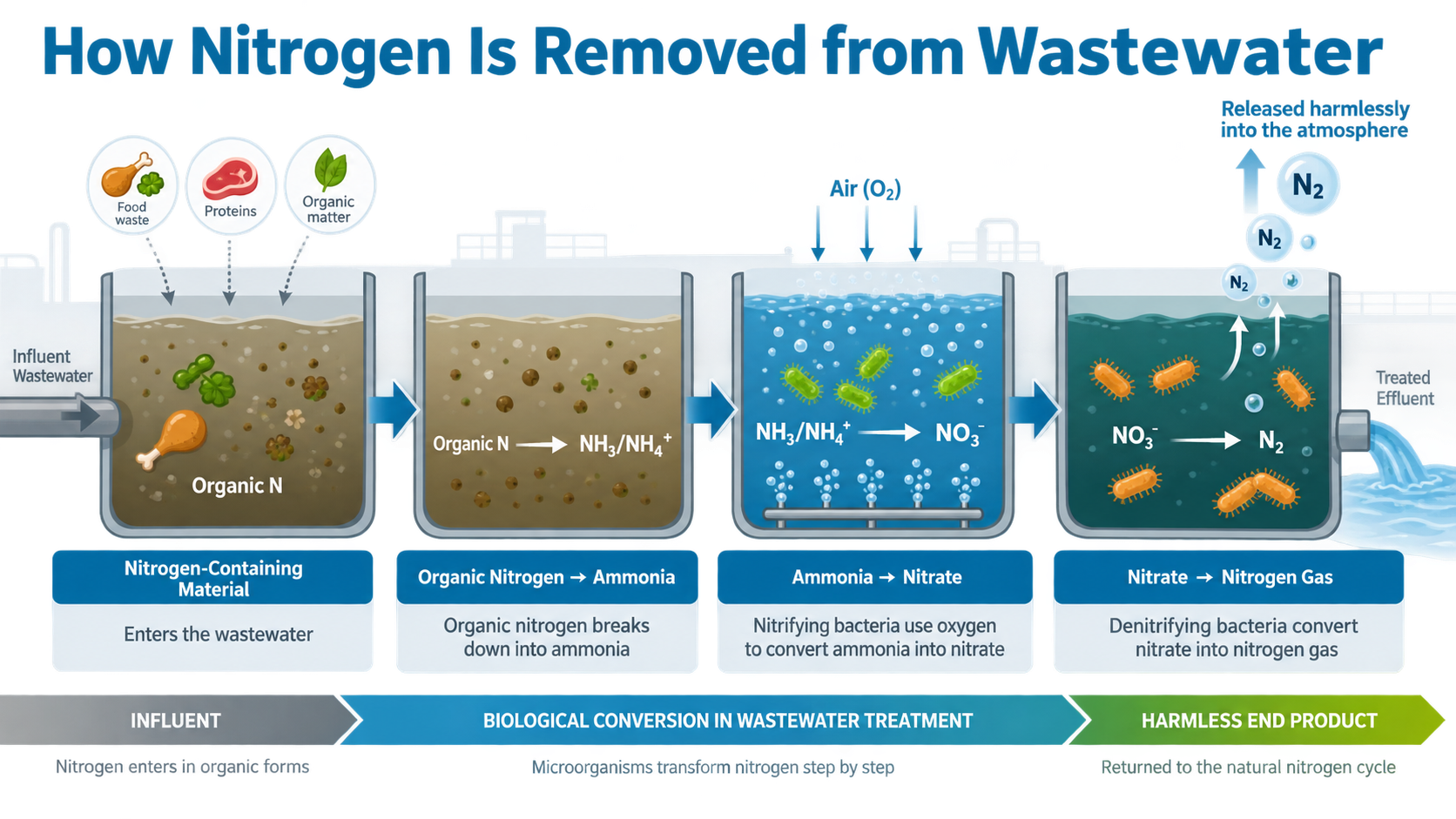
As the ammonia load increases, the treatment system may need:
• More oxygen to support nitrification
• More alkalinity to maintain stable pH conditions
• Sufficient solids retention time (SRT) and nitrifying biomass to maintain nitrification,
• More reliable control of SRT, temperature, pH, and dissolved oxygen
The right approach for effective nitrogen removal depends on where the nitrogen originates, how concentrated it is, whether sufficient carbon and oxygen are available, what the discharge requirements are, and how the existing treatment system is configured.
Nitrogen Management Strategies
Two technologies that may enter this conversation at this point are an anoxic selector and sidestream deammonification.
Although both can contribute to a broader nitrogen-management strategy, they address different treatment needs and are not direct substitutes.
What is a Pre-Anoxic Dentrification Zone (like an Anoxic Selector)?
A selector is a relatively small, intensely mixed zone or tank positioned near the beginning of an activated sludge treatment process. Incoming wastewater and return activated sludge (RAS) are brought together under controlled aerobic, anoxic, or anaerobic conditions.
Anoxic (meaning "without oxygen") is an environment that lacks dissolved oxygen but still contains chemical-bound oxygen (such as nitrite, nitrate, or phosphate) typically corresponding to an Oxidation Reduction Potential (ORP) values between -100mV and +100mV.
The purpose is to create an environment that favors microorganisms with desirable growth and settling characteristics. Properly designed selectors can help suppress filamentous organisms and encourage the formation of stronger, better-settling biological floc. Research defines selectors as zones upstream of the main aeration basin that create a concentrated substrate environment and notes that aerobic, anoxic, and anaerobic selector configurations have been used to control filamentous bulking.
In an anoxic selector, nitrate can serve as the electron acceptor while readily biodegradable carbon in the incoming wastewater supplies the energy needed for denitrification. The process therefore can accomplish several objectives:
• Reduce nitrate as part of the facility’s overall nitrogen-removal process
• Use influent carbon for denitrification before that carbon is consumed aerobically
• Reduce a portion of the downstream aeration demand
• Improve the capacity and stability of an existing activated sludge system
• Improve sludge settleability and help control filamentous growth
An important technical distinction is that an anoxic selector does not independently remove incoming ammonia. Ammonia must first be converted to nitrate or nitrite through nitrification in an aerobic portion of the treatment process. An internal mixed-liquor recycle (IMLR) stream can then return that oxidized nitrogen to the anoxic zone, where denitrifying organisms convert it to nitrogen gas.
The selector is therefore part of an integrated mainstream biological treatment strategy rather than a stand-alone ammonia-removal reactor.
When Does a Selector Make Sense?
An anoxic selector may be attractive when a facility:
• Wants to integrate nitrogen removal into an existing activated sludge process
• Has sufficient readily biodegradable carbon in its wastewater to support denitrification
• Has available nitrification capacity or can add that capacity in the aerobic system
• Needs a relatively straightforward and operationally familiar treatment configuration
• Needs to improve sludge settling or address filamentous bulking
For food and beverage facilities, the availability of biodegradable organic carbon can make a selector especially valuable. Instead of treating BOD only as a load to be removed through aeration, the system can use a controlled portion of that carbon to support denitrification, and simultaneously reduce BOD load to the aeration system.
However, selector performance depends heavily on wastewater characteristics, solids retention time, selector loading, mixing, recycle configuration, and operating conditions.
What Is Sidestream Deammonification?
Sidestream deammonification is designed for a very different application: treating a separate, concentrated, ammonia-rich liquid stream before it returns to the main treatment process.
These sidestreams are commonly associated with solids processing, particularly reject water or centrate generated during the dewatering of anaerobically digested biosolids. The Water Research Foundation identifies high ammonia concentration, elevated temperature, and limited alkalinity as characteristics that can make dewatering reject water both challenging and suitable for specialized sidestream treatment.
Deammonification typically combines two biological steps:
• Ammonia-oxidizing bacteria convert a portion of the ammonia to nitrite.
• Anaerobic ammonium-oxidizing bacteria, commonly called anammox bacteria, use the remaining ammonia and the produced nitrite to form nitrogen gas.
Unlike conventional denitrification, the anammox portion of the process does not require an organic carbon source.
Because only part of the ammonia is oxidized aerobically and supplemental carbon may not be required, deammonification can lower oxygen and external-carbon requirements compared with conventional nitrification-denitrification. It has proved effective for nitrogen removal from dewatering reject water and can be particularly attractive when mainstream nitrogen removal would otherwise require added carbon or alkalinity.
When Does Sidestream Deammonification Make Sense?
Sidestream deammonification may warrant consideration when a facility:
• Produces a distinct, concentrated, ammonia-rich sidestream typically through anaerobic digestion and biosolids dewatering processes that recycle ammonia to the main plant
• Wants to reduce that load before it reaches the main biological process
• Faces limitations in mainstream aeration or nitrification capacity
• Has the operational resources and process controls required to maintain specialized biological populations
For facilities with an identifiable concentrated side steam, there may be many economic and biological advantages for separate deammonification. However, many food and beverage plants do not produce a sidestream with the flow, temperature, alkalinity, or ammonia characteristics.
Selector Versus Sidestream Deammonification
The most useful comparison is not “Which technology is better?” It is “Where is the nitrogen, and what problem are we trying to solve?”
An anoxic selector is generally part of the mainstream process - It receives plant wastewater and return biomass, uses available organic carbon, supports denitrification, and can improve sludge settleability and overall biological-process performance.
Sidestream deammonification treats a concentrated recycle stream, targeting a relatively small flow carrying a disproportionately high ammonia load and removes much of that load before the sidestream returns to the main treatment system.
A selector supports a broader treatment process
It still depends on an aerobic nitrification step to convert ammonia into nitrate or nitrite before denitrification can occur.
Deammonification directly converts ammonia and nitrite to nitrogen gas. It requires careful process control to retain slow-growing anammox organisms and limit competition from nitrite-oxidizing bacteria.
What Other Nitrogen-Management Options Are Available?
Selectors and deammonification are only two tools within a broader nitrogen-management strategy options.
Depending on the wastewater, existing infrastructure, discharge requirements, and available footprint, other approaches may include:
• Simultaneous nitrification-denitrification: Carefully controlled oxygen conditions allow nitrification and denitrification to occur within the same basin or biological floc.
• Pre-anoxic or post-anoxic treatment: Anoxic zones can be positioned before or after aerobic treatment depending on carbon availability and the required effluent quality.
• MBBR or IFAS systems: MBBR or IFAS increase nitrifying biomass inventory and ammonia-removal capacity without requiring a proportional increase in suspended-growth basin volume. Internally, Probst has evaluated an MBBR/IFAS alternative incorporating an anoxic selector to improve capacity, nutrient removal, and settleability.
• Conventional sidestream nitrification or nitrogen removal: A concentrated recycle stream can be treated using conventional biology instead of anammox when the facility’s conditions or operational needs favor that approach.
• Bioaugmentation or sidestream nitrifier cultivation: A sidestream process can grow nitrifying organisms that are returned to the mainstream system, strengthening mainstream nitrification. The Water Research Foundation identifies pre-nitrification and bioaugmentation regeneration as options for managing reject-water nitrogen.
• Post-aerobic digestion: Residual ammonia can be nitrified after anaerobic digestion, with nitrogen removal potentially achieved through controlled simultaneous nitrification-denitrification or related pathways.
The Right Technology Starts with the Right Question
Advanced wastewater treatment is not about selecting the most complex technology. It is about understanding the complete treatment system and applying the right process in the right location.
For one facility, an anoxic selector may provide a practical way to improve settling, use influent carbon more efficiently, support nitrogen removal, and increase biological-process stability.
For another, a concentrated ammonia-rich recycle stream may justify sidestream deammonification.
For many food and beverage processors, the right solution may be an integrated combination of process optimization, selectors, additional nitrification capacity, biofilm technology, sidestream management, or operational modifications.
The Probst Group’s wastewater engineers, scientists, and operators evaluate the complete process, from production and wastewater generation through final treatment. By identifying where nitrogen enters the system and how it moves through the treatment process, we can help determine which strategy provides the right balance of performance, capacity, operating cost, reliability, and long-term flexibility.
Wastewater isn’t a side issue for food and beverage manufacturers. It’s a critical operational challenge - one that requires specialized knowledge, practical experience, and solutions designed around the unique challenges of each facility.
The Probst Group combines generations of wastewater expertise with hands-on operational experience to help food and beverage manufacturers:
• Achieve and maintain compliance
• Improve treatment performance
• Reduce operational risk
• Prepare for future growth
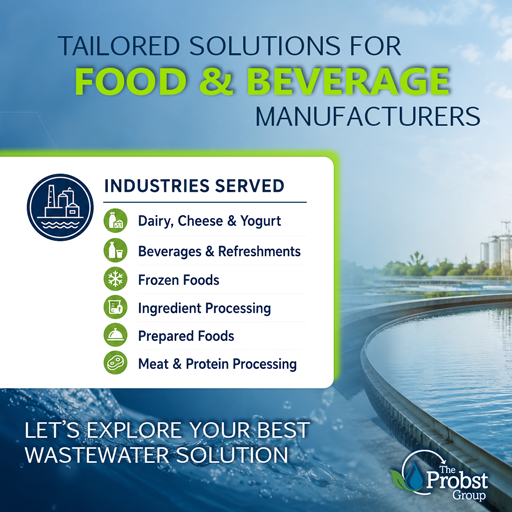
While we’re well known for our deep roots in the dairy industry, our experience extends across a wide range of food and beverage sectors, including:
• Dairy, cheese, and yogurt
• Beverages and refreshments
• Frozen foods
• Ingredient processing
• Prepared foods
• Meat and protein processing
Each industry – and each facility – generates wastewater with unique characteristics, operational demands, and regulatory requirements. That’s why we don’t believe in one-size-fits-all treatment solutions.
From permitting and process engineering to design, construction, optimization, and operations support, our comprehensive suite of wastewater solutions allows us to provide a tailored solutions based on the facility’s specific needs.
Effective wastewater treatment is about more than just compliance. It can improve efficiency, protect natural resources, reduce risk, and create a stronger foundation for sustainable growth.
Let’s explore your best wastewater solution.
During the warmer parts of the year, thermal limits can become asignificant concern for food & beverage producers.
Why Temperature Matters
When wastewater permitting discussions occur in the food and beverage industry, most conversations focus on familiar parameters such as BOD, TSS, phosphorus, nitrogen, or pH.
However, temperature can also play a significant role in permit compliance - particularly for facilities that discharge fully treated wastewater directly to rivers, streams, lakes, or other surface waters.
Excessive temperature increases can negatively affect fish and aquatic life within these receive waters by reducing dissolved oxygen (DO) levels, altering habitat conditions, and disrupting natural biological processes. As a result, facilities discharging to surface waters under a Wisconsin Pollutant Discharge Elimination System (WPDES) permit may be subject to temperature-related requirements or thermal limits.
Unlike conventional wastewater parameters that are measured as concentrations, thermal requirements focus on the heat load being introduced into the receiving waterbody and the resulting impact on ambient water temperatures. Permit limits are typically developed to ensure compliance with Wisconsin's water quality standards for the specific receiving stream, river, or lake.
Why Food and Beverage Facilities Can Face Thermal Challenges
Many food and beverage processes generate warm wastewater as a natural byproduct of production.
Commonsources include:
How Thermal Limits Are Evaluated
Thermal permit requirements are generally developed based on the characteristics of the receiving waterbody and the aquatic communities it supports. These factors can include: waterbody classification, seasonal conditions, and ambient water temperatures. Once determined, applicable limits may be expressed as weekly average temperatures, daily maximum temperatures, or other temperature-based restrictions incorporated into a discharge permit.
Because thermal impacts are highly site-specific, evaluating compliance often requires a combination of monitoring data, receiving water information, and thermal modeling.
Common Strategies for Managing Wastewater Temperature
When thermal limits become a concern, there are several options available to reduce effluent temperatures before discharge.
Equalization and Retention Time
One of the simplest and most cost-effective approaches is providing additional retention time within existing equalization or treatment basins.
As wastewater remains in tanks or lagoons,natural heat loss occurs through convection, evaporation, and contact withsurrounding air and soil.
In many cases, existing infrastructure can provide meaningful cooling withoutsignificant capital investment.
Cooling Ponds and Lagoons
Dedicated cooling ponds or lagoons arefrequently used when substantial temperature reduction is required.
These systems maximize surface area anddetention time, allowing heat to dissipate naturally before discharge.Facilities with available land often find this approach attractive due to itsoperational simplicity and relatively low energy requirements.
Mechanical Cooling Systems
For facilities with limited space or in needof more aggressive cooling mechanical cooling technologies may be appropriate.
This can include:
· Cooling towers
· Closed-loop heat exchangers
· Fluid coolers
· Evaporative cooling systems
These systems can provide predictabletemperature reductions but typically involve higher capital and operatingcosts.
Process Water Reuse
In some situations, facilities can reducethermal discharge concerns by reusing warm process water elsewhere within theoperation.
Heat recovery and reuse strategies cansimultaneously reduce energy consumption and lower wastewater temperatures,creating both environmental and economic benefits.
Production and Flow Management
Operational changes, such as staggeringhigh-temperature process discharge and optimizing CIP schedules can also helpmitigate thermal impacts.
These operational improvements are oftenoverlooked but can significantly reduce peak wastewater temperatures.
The Importance of Early Planning
Thermal limits are often easier and less expensive to address during the planning stages of a project than after permit conditions have been established.
Whether evaluating a facility expansion, increasing production capacity, or considering a new direct discharge, understanding potential thermal impacts early allows facilities to incorporate temperature management strategies into overall wastewater planning.
By evaluating thermal considerations alongside flow, loading, treatment performance, and permitting requirements, facilities can reduce compliance risk while avoiding costly retrofits in the future.
If you're concerned about meeting your thermal limits, our experienced team is here to provide solutions to help you protect aquatic life and meet your thermal limits.
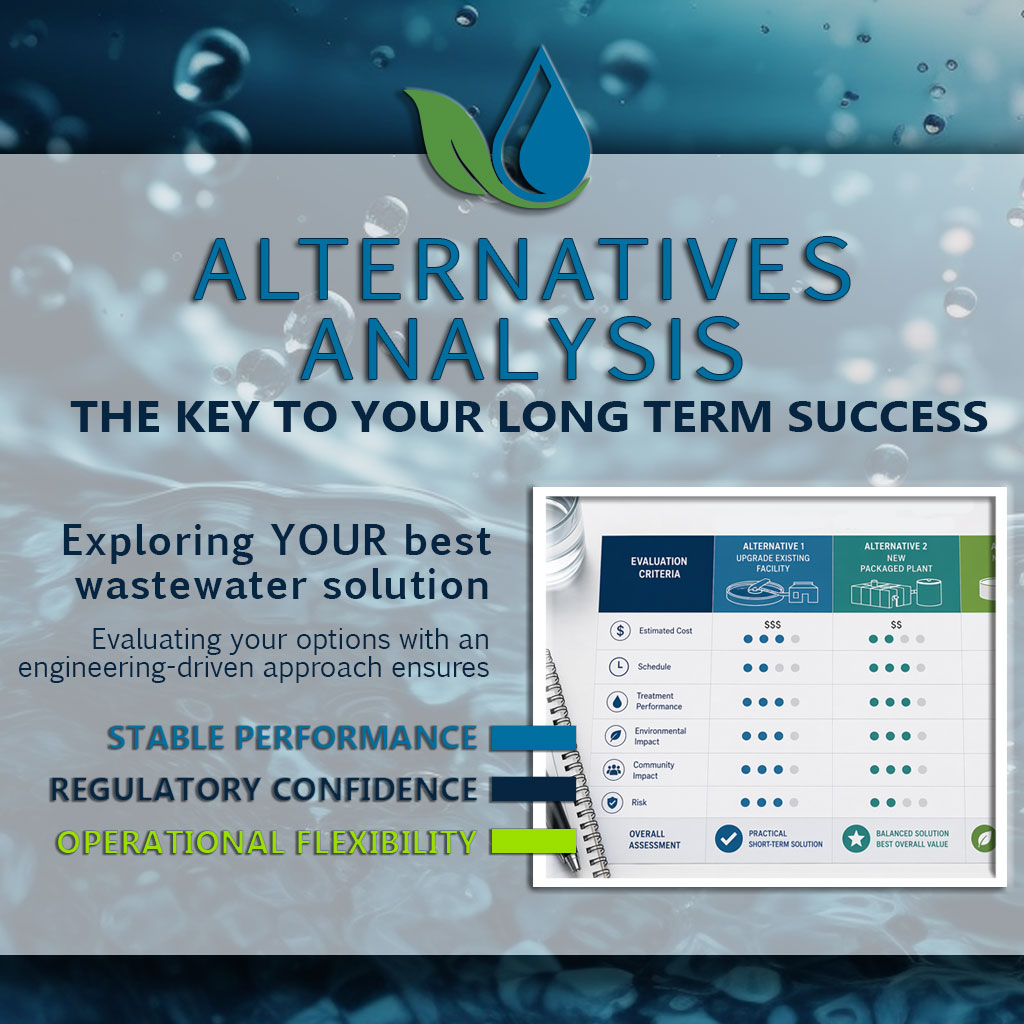
Beyond the Basis of Design: Why Alternatives Analysis isthe Key to Long-Term Success
In a recent post, we emphasized the importance of targeted sampling and fully understanding your waste stream as the foundation of any successful wastewater project. (Missed that post? You can catch up here.)
That work is what allows a facility to move beyond reactive “fire-fighting” and toward a proactive, engineered strategy that truly delivers long-term results and flexibility. Through targeted sampling, you begin to establish a defensible basis of design - one grounded in real operating data, not assumptions.
At this stage, you’ve identified your key waste streams, quantified variability, and defined the parameters driving operational risk - whether that’s BOD spikes, FOG (Fat, Oil, and Grese) loading, flow variability, or nutrient imbalances.
But once you reach that level of clarity, the question becomes: what do you do with it?
For many facilities, this is where the process starts to accelerate - sometimes in the wrong direction.
There’s often pressure to move quickly into a solution. Apiece of equipment is suggested. A vendor proposes a system. Internally, there’s a push to “just fix it” and restore stability. And while those instincts are understandable - especially when compliance or production is at stake - they can lead to premature decisions and costly headaches.
The reality is, there is rarely just one viable solution.
In fact, there are often multiple approaches that can address the immediate issue. A system may bring a lagoon back into compliance. A pretreatment upgrade may reduce surcharges. A single unit operation might smooth out a specific bottleneck. On paper, many of these options can “solve” the problem in front of you.
But wastewater treatment systems don’t operate on static conditions. They operate in environments defined by variability - seasonal production swings, changes in product mix, cleaning cycles, expansion plans, and evolving discharge limits. A solution that performs well under current conditions can quickly become a constraint if it wasn’t selected with that variability in mind.
That’s where many systems begin to fall short - not because they were poorly designed, but because they were selected too narrowly. Wastewater treatment is not a one-size-fits-all application. And more importantly, it’s not a single-point-in-time decision.
The most successful wastewater treatment projects - the ones that deliver stable performance, regulatory confidence, and operational flexibility over the long term - are built on a much more disciplined approach. They start with a comprehensive Alternatives Analysis.
A true Alternatives Analysis goes beyond comparing equipment or price points. It is a structured, engineering-driven evaluation of multiple treatment pathways, each assessed against a consistent set of criteria:
Rather than asking, “What will fix today’s issue?” the question shifts to:
“What solution is best aligned with where this facility is going - and how it operates in the real world?”
That shift is what separates short-term fixes from long-term infrastructure decisions.
Because at the end of the day, the goal isn’t just compliance. It’s building a system that performs reliably under changing conditions, supports production growth, and reduces operational risk over time.
And that starts by taking the time to explore the full landscape of viable solutions - before committing to just one.
Understanding the Role of Alternatives Analysis
An effective alternatives analysis is not a side-by-side comparison of equipment - it’s a decision framework that connects your wastewater strategy directly to your facility’s long-term business objectives.
At its core, the process starts with defining what success actually looks like for your site. That’s rarely a single metric. It’s a balance of compliance, reliability, operating cost, labor usage, and future growth combined with other factors or initiatives that may be unique to your facility.
The analysis forces a critical alignment:
What are you trying to achieve - and what are the real-world constraints of your operation?
From there, the approach broadens. Rather than evaluating a single path, the alternatives analysis explores a full range of viable treatment strategies, each assessed against consistent technical, operationa criteria, and overall costs – including both capital and operational. The goalis not just to identify a solution that works today - but to determine whichapproach will continue to perform as your facility evolves.
How a Comprehensive Analysis Takes Shape
To get there, the evaluation has to move beyond surface-level comparisons and into a deeper, more structured assessment.
Key areas of focus typically include:
The Risk of Vendor-Led Decisions
In the food and beverage industry - particularly in dairy - there is no standardized wastewater profile. No two facilities operate the same way, and no two waste streams behave identically.
That reality makes “pre-packaged” solutions inherently limited.
Technology providers are often highly knowledgeable within their specific offering - but their recommendations are naturally framed within the scope of what they sell. That’s not inherently wrong, but it is inherently narrow.
The risk is that the solution becomes defined before the problem is fully understood.
An independent, engineering-led approach shifts that dynamic. Instead of starting with a product, the process starts with you, your facility, your data, your variability, your constraints, and your goals.
From there, technologies are evaluated as tools - not starting points.
That distinction matters, because it’s often the difference between a system that checks a box - and one that continues to perform as conditions change.
Moving From Strategy to Execution
When a facility invests the time to complete a rigorous Alternatives Analysis, it fundamentally changes how decisions are made - and how projects perform.
At the end of the day, wastewater treatment isn’t just about maintaining compliance.
It’s about ensuring that your infrastructure supports production - consistently, predictably, cost-effectively, and without becoming a constraint on growth.
Facilities that approach wastewater this way don’t just solve problems - they build systems that absorb variability, adapt to change ,and operate as long-term assets.
And that begins by translating your basis of design into a clear, evaluated path forward - before a single piece of equipment is selected.

